What Muscles Does a Rowing Machine Work: Full Body Breakdown

Rowing machines are becoming very popular because of their efficient benefits for cardiovascular health. Unlike other machines that usually target our lower body, the rowing machine targets our upper and lower body, both and targets 80 to 90 per cent of our body muscle mass, making it the most efficient and unparalleled full body workout. Most people make mistakes while doing the rows, so in that article, we will talk about how to do rows and what muscles does a rowing machine work.
Phases Of Rowing Stroke And Muscle Activation
To understand the muscular engagement of rowing, first, we break down the four phases of the stroke:
- The Catch (starting position)
- The Drive (power phase)
- The Finish (end of power)
- The Recovery (return to start)
Primary Muscles Worked By Rowing Machines
Lower Body Muscles
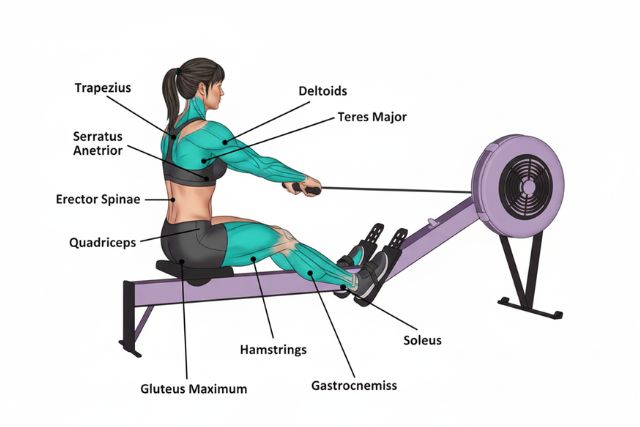
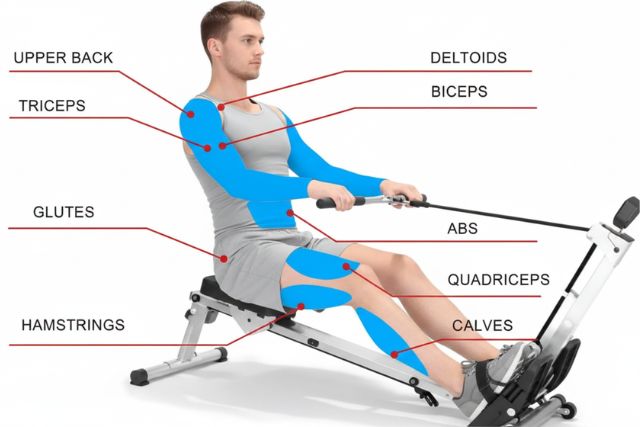
Quadriceps: During the initial portion of the drive phase, your quadriceps contract powerfully to extend the knees, generating approximately 60% of the stroke’s power. The specific muscles of the thighs that are targeted are the rectus femoris, vastus lateralis, vastus medialis, and vastus intermedius, showcasing that what muscles does a rowing machine work of our lower body. To get the maximum engagement, ensure that you bends knees fully at catch and controlled extension during the drive.
Glutes: The glutes engage strongly during the dive when you push through the drive phase, particularly during the dive phase. Glutes provide the stability and power during the movement. To put more pressure on the glutes, focus on squeezing them at the end of the drive phase.
Hamstrings: Hamstrings are located at the back of the thighs. Hamstrings are contracted when your knees approach near the extension during the second half, and also during the recovery phase when you flex the knees. Rowing balances the quad and hamstring development more precisely than other cardio workouts like cycling.
Calves: It stabilize the ankle throughout the stroke and assist in power transfer during the drive. Calves are not primary movers, but they provide stabilisation that enhances the overall output.
Core And Trunk Stabilisers
Erector Spinae: Erector spinae is our lower back that helps us to maintain proper spinal alignment, particularly during the drive phase. A proper back position is important to avoid any kind of injury. Keep your back straight during the movemnt not rounded.
Obliques: They engage during the movement to maintain the torso stability and to prevent the rotational movement during the drive. It develops the rotational stability crucial for daily activities and athletic performance.
Upper Body Muscles
Lats: The primary muscle that moves during the movement, particularly when you pull the handle towards your torso. While performing it, think of a pencil squeezed between your shoulder blades when you finish the drive. The lats make your overall back V-shape, showing that what muscles does a rowing machine work effectively targets.
Rhomboids and Trapezius: The rhomboids are our mid back muscles, and trapezuis muscles are our upper back muscles. These muscles are crucial and play a major role from dislocating the shoulder and neck muscles.
Deltoids: The deltoids are the muscles that make up our shoulder area. They help initiate the arm pull, while posterior deltoids assist in scapular retraction.
Biceps and Forearms: Biceps engage when you pull the handle towards your torso. Forearms work isometrically to maintain the grip on the handle throughout the stroke.
Rowing Mistakes That Should Be Avoided
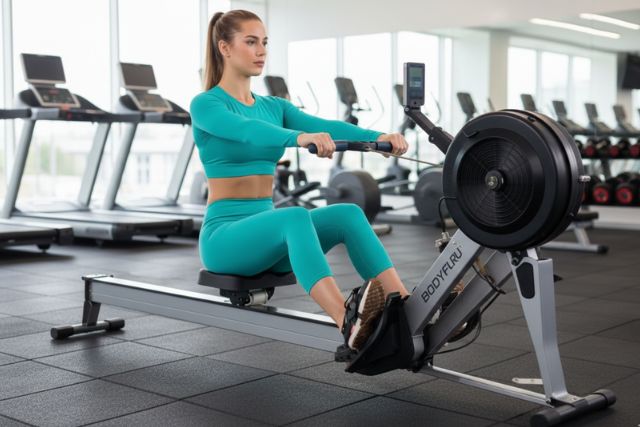
Rowing seems a simple exercise that everybody thinks can be done easily. But people make many mistakes while doing the rows. Certain mistakes are preventing you from taking the full advantage. These mistakes are discussed below:
Poor Posture: Rounding your back while performing the exercise can be harmful to your lower back. Rounded back will also decrease the effect of exercise and limits what muscles does a rowing machine work effectively. Maintain a proud chest and spine neutral during the movement. Thinking of pivoting the shoulder set and back flat. Your core should be engaged during the movement.
Not Doing the Warmup: Warming up is the most important part of any kind of workout. It prepares your body for the upcoming hard work. The warm-up on the rowing should start with a low-intensity cycling, cardio, etc., to circulate the blood in the whole body. Doing the watmup wil prevent your body from any kind of injury.
Sequence Error Arms, Back, Before Legs: Pulling the handle with arms or back wastes your most important muscle group. When you are about to start, pull with the legs until they are straight, like performing a horizontal leg press.
Rushing the stroke: If you rush throughout your stroke, you won’t generate too much power. If you are rushing your recovery, bending the legs too early, you will not be able to properly activate your hamstrings.
Rowing Too High and Skying The Hands: Pulling the hands too high during the movement or over the knees will lead to an insufficient power supply and choke. To fix that, keep your hands level in a straight line, not up and down, over your ankles and around the knees. This proper path allows for optimal force transfer from the legs and core, showcasing what muscles does a rowing machine work.
Rowing Only With The Arms: During weight training, rows isolate your back and biceps. However, during the rows, your back and the biceps do not contribute too much. Your legs are the major muscle group that contributes to rowing. While a little part of the core also contributes during it. By rowing faster, you will not see such results. It will only waste your energy, because arms are not a major muscle group. To get maximum results and to know what muscles does a rowing machine work, put force on the legs until they get straightened and maximum force is generated through them. Our legs are the major muscle group that produces maximum force during the workout.
Going All Out All the Time: Doing every row with a 100 per cent maximum effort. This will lead to reinforcing aerobic development, fatigue and bad technique. Spend 70 to 80 per cent of your time at a comfortable pace, doing 16 to 22 strokes per minute, focusing on the perfect form.
Conclusion
The rowing machine can give a full body workout at a single machine and build cardiovascular endurance, functional movement and strength. Engaging all your muscles at a single time gives you real-world strength and resilience.
Whether your goal is to lose weight, improve athletic performance, and building strength, knowing that what muscles does a rowing machine work will help you get maximum results during the workout. By mastering proper technique and incorporating rows into a baclane fitness you will develop a strong and resilient physique that performs as well as it looks. For more fitness tips, visit this website Fitness Hubz.