

How to Run a Marathon: 10 Expert Tips to Train Smarter

Whether you’re a weekend jogger eyeing your first 26.2 or someone who has always dreamed of becoming a marathoner, this complete guide on how to run a marathon will walk you through every step from building your base to crossing the finish line with a smile on your face.
Table of Contents
- Understand What You’re Actually Signing Up For
- Choose the Right Marathon Training Plan
- Build Your Weekly Schedule Around Your Runs
- Break the Big Goal Into Smaller Milestones
- Nail Your Marathon Nutrition Strategy
- Master the Mental Side of Marathon Running
- Strength Train and Cross-Train Consistently
- Prioritize Sleep and Active Recovery
- Take Injury Prevention Seriously
- Give Yourself Grace and Keep Showing Up
- Frequently Asked Questions
- Final Thoughts
Why Learning How to Run a Marathon Changes You Before Race Day

I still remember sitting at my kitchen table, staring at my laptop screen, mouse hovering over the “Register” button. 26.2 miles felt impossibly far. But I clicked. And that single decision set off one of the most transformative journeys of my life.
Here’s the thing most people don’t tell you about learning how to run a marathon for beginners: the race itself is actually the easiest part. Race day is your victory lap. The real marathon the one that tests your character, reshapes your habits, and quietly builds an iron-clad version of you happens in the months of training leading up to it.
That’s why this guide goes deeper than a checklist. These are the top 10 tips for running your first marathon, built on real experience, coaching knowledge, and the kind of honest insight that actually helps you show up to the start line ready.
1. Understand What You’re Actually Signing Up For
Before you can figure out how to run a marathon, you need to get honest with yourself about what marathon training demands. We’re not talking about a quick 5K here.
Most training plans run 16 to 20 weeks. During peak training, you’ll run 35 to 50 miles per week spread across 4 to 5 days. Your long runs the weekend cornerstone of any solid plan will climb from 10 miles up to 20 or 22 miles in the final weeks before taper.
That means early alarms, Saturday mornings on the road while everyone else is sleeping in, and Sundays where your legs feel like borrowed furniture. It means planning meals around runs, saying no to some social events, and learning how to fuel your body in ways you never had to before.
None of this is said to scare you it’s said to prepare you. Because the runners who struggle most are the ones who underestimated what they were walking into. Go in with eyes open, and you’ll be miles ahead.
Are You Ready? Check These Boxes First:
- You can comfortably run 3 to 5 miles without stopping
- You’ve been running consistently for at least 3 to 6 months
- You have at least 16 weeks before your target race
- You’re willing to commit 6+ hours per week to training
2. Choose the Right Marathon Training Plan
Think of your training plan as the backbone of your entire marathon journey. Without one, you’re essentially freestyling and freestyling over 26.2 miles rarely ends well.
The good news? There are outstanding free plans designed specifically for how to run a marathon for beginners. Hal Higdon’s Novice 1 program is the gold standard for first-timers — it’s structured, progressive, and built to get you to the finish line without burning you out. Jeff Galloway’s run-walk method is another fantastic option if you’re newer to distance running.
What to Look for in a Good Plan:
- A gradual weekly mileage increase (no more than 10% per week)
- At least one rest or easy recovery day per week
- A proper taper period (2 to 3 weeks before race day)
- Long runs that peak around 20 miles about 3 weeks out
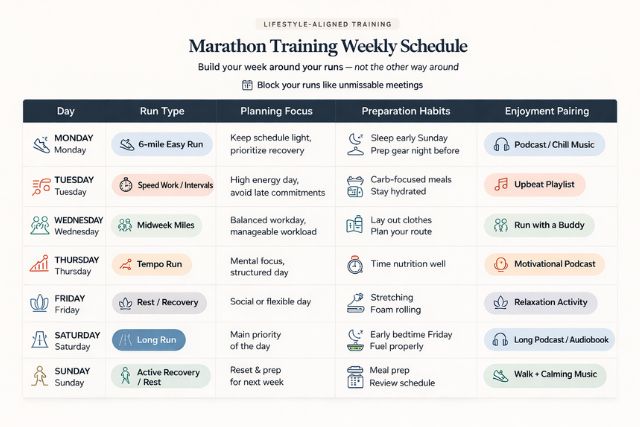
3. Build Your Weekly Schedule Around Your Runs
Here’s a mindset shift that makes marathon training sustainable: stop trying to fit your runs into your life, and start building your life around your runs.
That might sound dramatic, but it’s practical. When you know Monday is a 6-mile easy run, you plan Monday accordingly. You go to bed on Sunday at a reasonable hour. You prep your running clothes the night before. You know dinner will be something that digests well.
At the start of each week, look at your training plan and block those sessions into your calendar like meetings you can’t cancel because you can’t. This is one of the most effective strategies for learning how to run a marathon without letting it derail your entire life.
Pro tip: pair your runs with something you enjoy. A great podcast for long runs, a music playlist for speed work, a running buddy for midweek miles. Make the process enjoyable and it becomes something you look forward to rather than dread.
4. Break the Big Goal Into Smaller Milestones
26.2 miles is an enormous number. Staring at it every day during training is a recipe for overwhelm, especially when you’re learning how to run a marathon. So don’t stare at it.
Instead, break your marathon training into a series of smaller, winnable goals. This is one of the top 10 tips for running your first marathon that coaches swear by — and it works because the human brain responds better to near-term wins than distant abstract ones.
A Simple Milestone Framework:
- Month 1 Goal: Run a comfortable half-marathon distance in training
- Month 2 Goal: Hit 16 to 18 miles on a long run
- Month 3 Goal: Complete your 20-mile long run
- Race Week: Trust the taper, your body is ready
Celebrate every milestone. Finished your first 15-miler? That deserves recognition. Ran five straight weeks without missing a session? That’s a win. These small victories build the confidence that carries you through race day.
5. Nail Your Marathon Nutrition Strategy
You can have the best training plan in the world and still blow up on race day because you didn’t figure out how to fuel. Nutrition is one of the most underestimated elements of how to run a marathon successfully. That’s why having a solid marathon fueling strategy is just as important as your training plan.
Your body stores roughly 2,000 calories of glycogen which gets you to about mile 18 or 20 before those stores run dry. That infamous “wall” runners hit? That’s what happens when glycogen runs out and your legs suddenly feel like they’re made of wet concrete.
Marathon Nutrition Basics:
Before Long Runs:
- Eat a carbohydrate-rich meal 2 to 3 hours before you head out (oatmeal, toast with peanut butter, banana)
- Stay well-hydrated in the 24 hours leading up to any run over 10 miles
During Long Runs:
- Take in 30 to 60 grams of carbohydrates per hour after the first 45 to 60 minutes
- Practice using gels, chews, or dates during training never try anything new on race day
- Drink to thirst; don’t overhydrate
After Long Runs:
- Eat a meal with protein and carbohydrates within 45 minutes of finishing
- Chocolate milk, Greek yogurt with fruit, or eggs on toast are simple recovery options
The golden rule of marathon nutrition: practice everything in training. Your race day fuel strategy should be completely figured out and tested before you ever stand on that start line.
6. Master the Mental Side of Marathon Running
Nobody tells you this when you first register: running a marathon is at least 50% a mental event. Your legs might physically be capable of finishing, but your brain will start negotiating with you around mile 18 and that negotiation can go very badly if you’re not prepared.
Learning how to run a marathon means learning how to run through discomfort, doubt, and the compelling voice in your head that says “You can just stop and no one would blame you.”
Mental Strategies That Actually Work:
- Positive self-talk: Develop a short personal mantra like “strong and steady” or “mile by mile” and use it when things get tough
- Visualization: Regularly visualize yourself crossing the finish line feel it, picture it, believe it
- Breaking it down on race day: Instead of thinking about 26.2 miles, run to the next water station, then the next mile marker, then the next lamppost
- Reframe discomfort: Pain means you’re pushing. Remind yourself that every hard mile is making you stronger
- Find your why: Know exactly why you’re doing this and write it somewhere you’ll see it every day during training
7. Strength Train and Cross-Train Consistently

One of the biggest mistakes first-time marathoners make is treating training as nothing but running. But a stronger body is a more durable running body, and durability is everything when you’re learning how to run a marathon over 16+ weeks of training.
Incorporating two sessions of strength training per week, particularly targeting your glutes, hips, core, and hamstrings, can dramatically reduce your injury risk and improve your running economy. You don’t need a fancy gym setup. Bodyweight exercises like single-leg squats, glute bridges, deadbugs, and clamshells go a long way.
Cross-training (cycling, swimming, yoga, elliptical) is also worth building into your plan. On easy days or when your legs are beat up, swapping a run for a low-impact cross-training session keeps your cardiovascular fitness building without the pounding. This is one of the most overlooked tips in any guide on how to run a marathon for beginners.
8. Prioritize Sleep and Active Recovery
Your body doesn’t get stronger during training it gets stronger during recovery from training. That distinction matters enormously, especially when you’re learning how to run a marathon.
Sleep is the most powerful recovery tool you have, and it’s free. During deep sleep, your body repairs micro-tears in muscle fibers, regulates stress hormones, and consolidates motor patterns. Aim for 7 to 9 hours per night and don’t treat this as a luxury. When marathon training ramps up, your sleep needs go up too.
Recovery Habits Worth Building:
- Foam rolling for 10 to 15 minutes after runs to reduce muscle tightness
- Ice baths or cold water immersion after long runs (10 to 15 minutes at 50 to 60°F)
- Compression socks during the day after hard sessions
- A consistent pre-sleep routine: dim lights, no screens, cooler room temperature
- At least one full rest day per week is non-negotiable
Skimping on recovery is like trying to build a house while someone else removes the bricks behind you. Honor your rest days as much as your run days.
9. Take Injury Prevention Seriously
The most common reason first-time marathon runners don’t make it to the start line is injury and the frustrating thing is that most running injuries are preventable.
If you’re learning how to run a marathon, it’s important to understand that common issues like runner’s knee, IT band syndrome, plantar fasciitis, and shin splints almost always share the same root causes: ramping up mileage too quickly, skipping strength work, and ignoring early warning signs.
Your Injury Prevention Checklist:
- Follow the 10% rule: never increase your weekly mileage by more than 10% from the previous week
- Get properly fitted for running shoes at a specialty running store the right shoe changes everything
- Address niggles early: a 5-minute stretch routine done daily keeps small problems from becoming big ones
- Ice inflamed joints after hard runs; use heat for tight, sore muscles
- Listen to your body if something hurts (not just soreness), rest it or see a physio
It’s far better to miss one or two runs early in training than to miss the race entirely because you ignored a warning sign for six weeks.
10. Give Yourself Grace and Keep Showing Up
Here’s the most human tip in this entire guide: you will not execute your training plan perfectly. Nobody does.
You’ll miss a run because life happens a sick kid, a work deadline, terrible weather, an off day where you just can’t. You’ll eat badly before a long run and have a rough one. You’ll skip a strength session. You’ll go through a week where you question whether you even want to do this anymore.
That is completely normal. Marathon training is a long game, and the athletes who make it to the finish line aren’t the ones who ran every single mile perfectly they’re the ones who kept showing up even after an imperfect week.
Cut yourself some slack, reset, and get back out there. One bad run doesn’t define your training. One missed day doesn’t break your fitness. Consistency over perfection, that’s the real secret to learning how to run a marathon.
Frequently Asked Questions
When was running invented?
Running wasn’t invented at a specific time, it dates back to prehistoric humans who ran for survival, hunting, and escaping danger.
Over time, running evolved into a sport, becoming a key event in the ancient Olympic Games as early as 776 BCE.
How fast can Usain Bolt run?
Usain Bolt is the fastest human ever recorded, reaching a top speed of about 44.7 km/h (27.8 mph) during his 100m world record in 2009.
How long does it take to train for a marathon?
For most beginners, 16 to 20 weeks is the standard marathon training window. If you’re new to running entirely, give yourself 6 months by building a base before starting a formal plan.
What should I eat the night before a marathon?
Stick to familiar, easy-to-digest carbohydrates: pasta, rice, bread, or potatoes with a lean protein source. Avoid anything high in fat, fiber, or new to your system. This is not the night to try a new restaurant.
Final Thoughts
There’s something quietly extraordinary about deciding to run a marathon. It’s a commitment that asks more of you than most things in life more early mornings, more discipline, more willingness to sit with discomfort and keep moving anyway.
But ask anyone who has crossed a marathon finish line what it felt like, and you’ll hear the same thing: it was worth every hard mile.
Now you have everything you need to understand how to run a marathon the training approach, the nutrition, the recovery, the mental game, and the mindset. The only thing left is to lace up and start. Follow for more fitness tips Fitness Hubz.